
Why Installing a Metal Roof Over Shingles in Martin County May Cost You More in the Long Run
Property owners across Martin County frequently ask whether they can bypass the tear-off process and place a brand-new metal roof right on top of their aging asphalt shingles. Often, the goal is straightforward: minimize project disruptions, eliminate dumpster clutter, or reduce initial upfront labor costs.
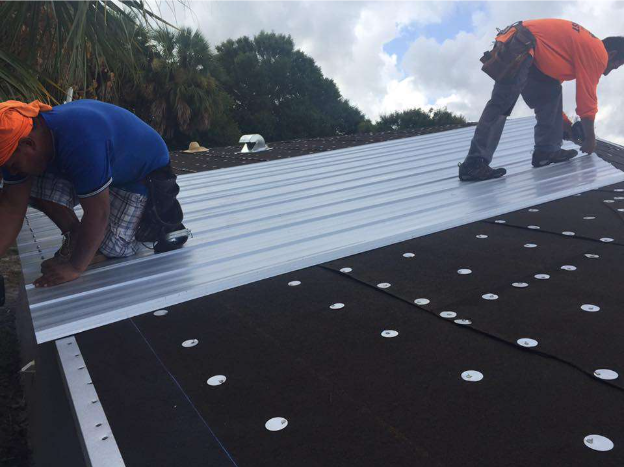
While certain Florida-approved metal roofing profiles can legally be permitted over a single layer of asphalt shingles under precise engineering conditions, a “roof-over” is rarely the smartest long-term decision for coastal homes.
In coastal communities like Stuart, Jensen Beach, Palm City, and Hobe Sound, weather extremes test every component of a building’s envelope. Placing new metal over old shingles frequently traps hidden structural decay, creates aesthetic flaws, and complicates insurance filings.
Here is what Martin County homeowners must consider before choosing a roof-over instead of a full tear-off.
1. You Cannot Verify or Reinforce the Roof Decking
A metal roof is only as durable as the plywood or OSB substrate anchoring it. When original shingles remain on the home, your contractor cannot examine the structural decking from above.
A complete tear-off allows roofers to:
- Pinpoint cracked, sagging, or delaminated wood panels.
- Replace moisture-compromised decking before adding weight.
- Re-nail and renail the wood deck to satisfy modern High-Wind and Florida Building Code (FBC) fastening schedules—drastically improving resistance against tropical storm uplift.
Leaving shingles in place forces fasteners to pass through degraded asphalt and felt before biting into decking of unknown strength.
2. Concealed Water Infiltration and Wood Rot Go Unaddressed
If an existing roof has suffered historical leaks, simply laying metal over the area does not fix the moisture trapped within the assembly.
- Loss of Fastener Grip: Screws driven into rotted, softened plywood cannot achieve their required pull-out resistance, leaving panels vulnerable to peel-back during strong coastal gusts.
- Persistent Fungal Growth: Trapped moisture beneath impervious metal panels can accelerate attic mold, interior drywall damage, and insulation breakdown.
- Costly Post-Installation Fixes: Discovering localized rot after modern metal panels are locked into place requires dismantling large sections of brand-new roofing, driving repair expenses far beyond what a standard tear-off would have cost initially.
3. Complications with Martin County Wind Mitigation & Insurance Premiums
Many homeowners invest in metal roofing expecting immediate wind mitigation discounts on their property insurance policies. However, adding metal over an existing roof covering can backfire during an inspection:
- Inability to Verify Deck Fasteners: Wind mitigation forms (OIR-B1-1802) require inspectors to verify deck attachment nail spacing and roof underlayment secondary water barriers (SWR). If shingles conceal the deck, an inspector may not be able to verify these critical safety features.
- Strict Underwriting Guidelines: Insurance underwriters along the Treasure Coast are increasingly stringent. Some private carriers refuse to insure properties with multiple roof layers or require proof of an inspected, bare-wood re-nailing before issuing windstorm credits.
Always speak with your insurance carrier regarding their specific underwriting standards before approving a roof-over proposal.
4. Shingle Surface Irregularities Telegraph Through the Metal Panels
Asphalt shingles deteriorate unevenly. Over years of exposure to South Florida’s heat, shingles curl, buckle, blister, and crack.
Metal panels—especially long-run standing seam profiles—require an exceptionally smooth, uniform surface:
- If installed over uneven shingles, structural metal panels can telegraph those underlying bumps, resulting in visible ripples, distortion, and an unattractive “oil-canning” appearance in bright sunlight.
- Stripping the deck bare ensures smooth, level underlayment application, clean panel transitions, and crisp architectural sightlines that enhance curb appeal.
5. Risk of Violating Product Approvals and Attachment Engineering
Every hurricane-rated metal roofing system must carry a verified Florida Product Approval (FL#) outlining exact installation standards.
- These manufacturer approvals specify allowable substrates, designated clip systems, precise screw lengths, spacing, and maximum design pressures.
- Many premium standing-seam assemblies explicitly require direct installation over approved, self-adhering high-temp underlayment applied directly to clean structural wood decking.
- Deviating from the tested installation specs can void the manufacturer’s warranty, cause the Martin County Building Department to fail the final inspection, and compromise wind uplift performance when severe weather arrives.
Is a Roof-Over Ever Allowed in Florida?
Yes. Florida Building Code does allow an approved metal roof system to be installed over a single layer of existing asphalt shingles under narrow criteria, provided the local building official approves the engineering and design pressures.
However, permitted does not equal optimal. For long-term structural integrity, a clean tear-off down to the bare decking provides the only guaranteed way to fix rotted framing, achieve optimal wind mitigation ratings, and protect your investment for decades to come.
Essential Questions to Ask Your Contractor Before Signing
Before agreeing to any roof-over estimate, ask the contractor:
- What is the specific Florida Product Approval (FL#) for this system, and does it explicitly approve installation over existing asphalt shingles?
- How will you verify that the underlying wood decking is completely free of rot?
- How will this installation method affect my Wind Mitigation inspection report and insurance discounts?
- Does installing over shingles alter or limit the manufacturer’s product or paint warranty?
- Will this project include a full Martin County building permit and final inspection?
Schedule a Professional Roof Assessment in Martin County
Whether you are considering a standing-seam metal upgrade or need an honest evaluation of your current shingle roof, work with an experienced Treasure Coast contractor who prioritizes code compliance and coastal engineering over quick shortcuts.
One Construction & Roofing Contractors
- Phone / Text: 772-200-1609
- Website: www.oneconstruction.com
- Florida State Certified Roofing License: CCC-1330623
- Service Area: Stuart, Jensen Beach, Palm City, Hobe Sound, and throughout Martin County & the Treasure Coast